




Why micro-pauses matter when life is busy
|
|
Time to read 9 min


|
|
Time to read 9 min
You know the feeling. Your mind is full, your to-do list keeps growing, and advice like “take a break” sounds unrealistic. Most people cannot pause their lives for a week and return refreshed. Responsibilities continue. Life keeps moving.
But what if rest does not require stepping away from everything?
What if what your mind needs is not more time off, but small moments of release that can happen inside an already full day?
When life is busy, the mind rarely gets real rest. Thoughts keep looping. Attention fragments. Even after tasks are finished, there is no sense of relief. The body keeps moving forward, while the mind never quite gets to put anything down.
What many people experience is not a lack of discipline. It is a lack of mental space.
Micro-pauses are small moments of intentional attention that help the mind release what it is holding.
They do not require planning, preparation, or leaving your life behind. They fit into the moments that already exist. A brief pause between tasks. A quiet moment at your desk. A short breath before moving on.
What matters is not how long the pause lasts, but what it allows. Even a brief pause can create enough space for the mind to loosen its grip, settle, and reset its focus.
Micro-pauses are not something you practice or build into a routine. They are moments you are allowed to take when your mind needs relief.
There is a common belief that calm only arrives once life finally slows down. That rest requires escape, stillness, or time away. But calm does not come from stopping your life.
It comes from creating small moments where the mind can release what it is holding.
Micro-pauses help because they work within real life. They do not ask you to do less. They help you let go.
When life is busy, rest has to fit inside the day you already have. It cannot depend on silence, free time, or ideal conditions. Micro-pauses work because they meet you where you are, not where you wish you could be.
A micro-pause is not a task to complete or a practice to maintain. It is a brief moment of attention that helps the mind release, even while life continues around you.
These moments are not meant to be followed or repeated in a specific way. They are simply examples of how release can happen when the mind feels full.
You might recognize a micro-pause in moments like these:
writing down a single thought so your mind does not have to keep holding it
noticing a few details around you, such as light, sound, or movement
taking a slow breath before moving on to the next task
closing your eyes for a moment to let attention settle
What matters is not the action itself, but the effect. The mind loosens its grip. Attention comes back to the present moment. Something tight is allowed to soften.
Micro-pauses do not need to be quiet, private, or perfect. They can happen at your desk, in between meetings, or in the middle of a busy day. They do not ask you to leave your life in order to rest from it.
Rest is often described as complete stillness. Lying down. Closing your eyes. Stepping away from everything. But rest can take many forms.
What makes something restful is not whether you stop moving, but whether your mind can shift out of constant problem solving. Writing on paper is an action, but it can still be restful. It moves thoughts out of your head and into the physical world, where they no longer need to be repeated.
You do not need to do nothing to rest.
You only need to do something that allows your mind to let go.
When your mind feels too full, it is often not because there is too much to do, but because there is too much being held at once. Thoughts repeat themselves not because they are important, but because the mind is trying not to forget them.
Writing something down once can create immediate relief. When a thought is placed on paper, the mind no longer needs to keep circling it. It has somewhere safe to put it, and can let it rest.
This is not about journaling or building a practice. There is nothing to keep up with. There is no right way to do it. The purpose is simple. To give the mind a place to release what it is holding, so it does not have to carry everything internally.
The physical act matters. Holding a pen. Feeling the paper. Noticing the movement of your hand. These small sensations bring attention back into the body. The relief that follows is often felt before it is understood.
The physical act matters too. Holding a pen, feeling the paper, noticing the movement of your hand brings attention back into the body. The relief that follows is something you can feel, not just understand.
If the idea of starting something new feels like another task on your list, it can help to think of paper as a place rather than a tool. It is not something you use correctly or incorrectly. It is simply available when you need somewhere to put things down.
Paper does not demand consistency. It does not require motivation. You reach for it when your mind feels full, and you leave it when you are done.
Below are a few ways people often allow the mind to release what it is holding, using nothing more than a piece of paper. These are not steps to follow. They are examples you may recognize.
Sometimes the mind is carrying too much at once. Writing everything down, tasks, worries, reminders, unfinished thoughts, gives them somewhere else to go. Nothing needs to be organized or solved. Once the page holds it, your mind no longer has to.
At times, clarity does not come from answers, but from naming what is present. Writing a single question, such as what you actually need right now, can be enough to soften the inner noise. Whatever appears does not need to be useful or complete.
When thoughts spiral, attention often needs a way back into the body. Writing down a few things you can notice, something you can feel, hear, or see, gently shifts attention away from thinking and toward presence.
Some worries cannot be acted on today, yet they keep asking for attention. Writing them down creates a temporary resting place. You are not dismissing these concerns. You are allowing yourself to stop carrying them for a while.
Energy changes with the seasons, whether we name it or not. Writing one sentence about how this season feels can bring quiet clarity. Sometimes naming what is already true is enough to soften the day.
You might find yourself reaching for a micro-pause at moments like these.
These moments do not signal failure or overload. They are simply signs that the mind has been holding more than it can comfortably carry.
Most people cannot step away from their responsibilities for long periods of time. Life does not slow down just because we need it to.
What is often possible is something smaller. Writing down one thought. Noticing the weight of the pen in your hand. Allowing a brief pause between one moment and the next.
These moments are not rewards you earn. They are not escapes from your life. They are small openings inside it.
Micro-pauses are not about getting away.
They are about finding steadiness where you already are.
Sometimes, that is enough.
If this way of pausing resonates, you do not need to figure out how to create these moments for yourself.
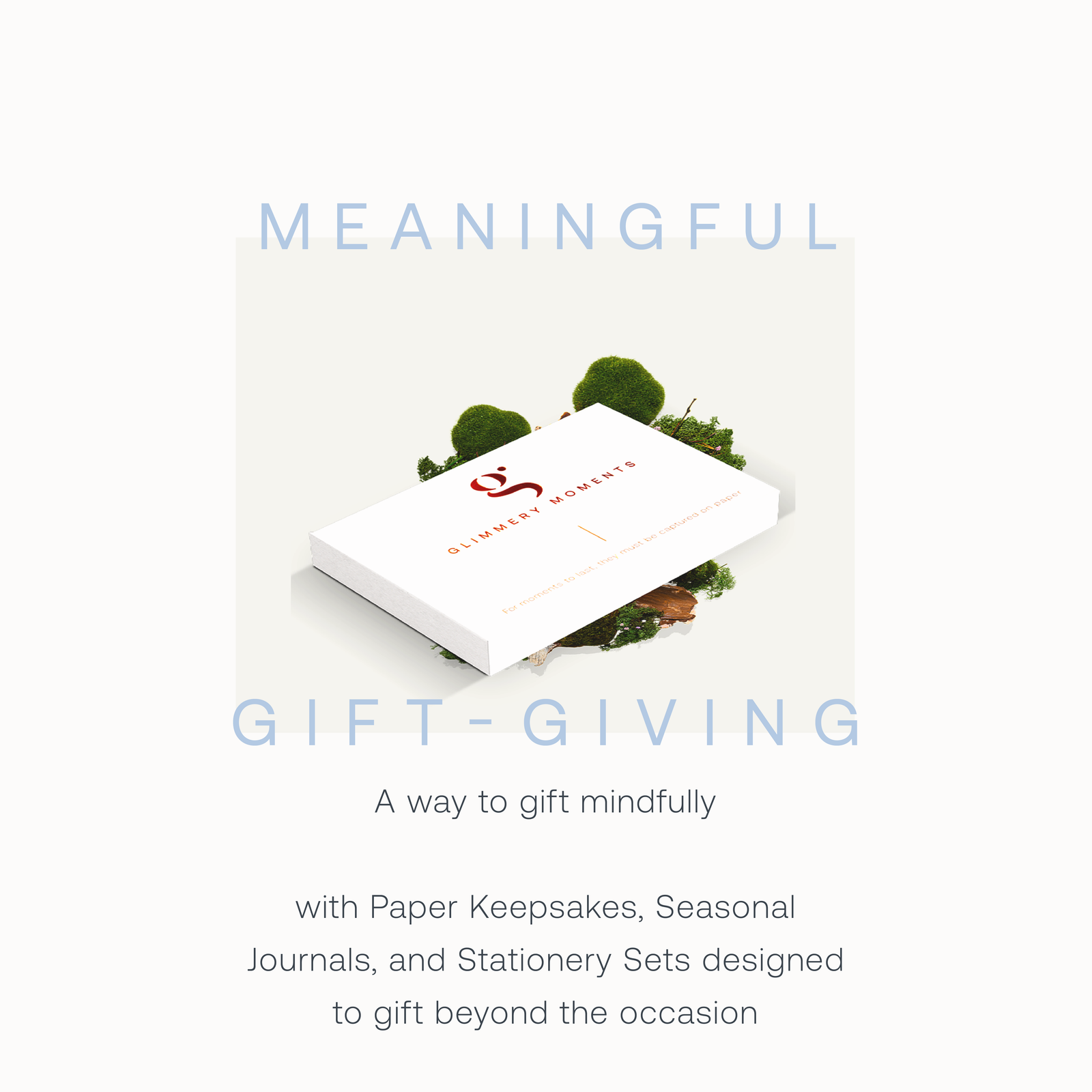
In our Paper Moment™, we bring these small pauses together in a simple, tangible way. The micro-pauses are already there, woven into the experience, so you do not have to think about what to do or when to do it. You simply arrive, open the page, and let the moment meet you.
Each Paper Moment is designed as a lived experience. A brief, sensory pause that helps the mind release without turning rest into another task. Writing prompts, space, and seasonal cues are held together in one place, so the pause feels natural rather than effortful.
You can use a Paper Moment when your day feels full, when your thoughts need somewhere to land, or when you want to return to yourself for a moment without stepping away from your life.
If you would like to support this work, you are welcome to explore our collection. If shopping does not feel right right now, sharing this page or passing the idea on is a meaningful way to keep this work moving forward.
At Glimmery Moments, we believe in care, continuity, and creating small, thoughtful experiences that help people feel more at home in their lives, even when life remains busy.
A micro-pause is a small moment of mental and sensory rest that fits into daily life. It usually lasts between 30 seconds and a few minutes and does not require stopping what you’re doing. A micro-pause creates space for the mind to let go of what it is holding, even briefly.
When life is busy, the mind often carries more than it can comfortably hold. Micro-pauses help by offering short moments of release. Instead of pushing through or waiting for life to slow down, they allow the nervous system to reset within the day itself.
Yes. Micro-pauses are designed for moments when time feels limited. They do not require long breaks, preparation, or a change of setting. Even a short pause can reduce mental overload and help you continue with more ease.
Writing on paper allows thoughts to move out of the mind and onto the page. This reduces the mental effort of holding everything internally. The physical act of writing also grounds attention in the body, making the pause feel tangible rather than abstract.
Micro-pauses are not a practice to maintain or perfect. They do not require stillness, silence, or a dedicated time. Unlike meditation, a micro-pause fits into everyday moments and works even when life is noisy, busy, or unfinished.
A micro-pause can help when thoughts loop, when you feel overwhelmed but need to keep going, or when you want to feel more present. You do not need a crisis or a reason — only a moment of attention.
Whether you're looking to prevent burnout, build emotional resilience, or simply create more space for rest in your busy life, the Mood Organizer offers a practical, beautiful tool to support your wellbeing journey.
Begin this season by planning in a way that truly supports your body, mind, and heart.

